Tracking Code

Showing posts with label religion. Show all posts

Wednesday, June 23, 2010

Baraka

I started reading a new book this morning, A Theory of Justice by John Rawls. It's a pretty weighty political philosophy text--social contracts and such. I read about it online a few days ago, while I was searching for people who had addressed the conundrum of whether and how to tolerate intolerance. I see occasionally reading books along these lines as a part of my attempt to strike a balance between engaging my rational, intellectual side on the one hand and nourishing other, more intuitive forms of knowing on the other.

Traveling, of course, I see as a way of learning about the world in a more intuitive, heartfelt way. I had a series of experiences on my birthday a few weeks ago, while I was still in Morocco that I think are a nice example of this.

I started the day in Fez, which is one of the four major, historic, imperial cities of Morocco, along with the current capital, Rabat, the heart of the tourism industry, Marrakesh, and Meknès, where I began my journey through the country.

Allow me to digress for a moment about Fez. I only spent a couple nights there, and that was all it took to win my heart and become my favorite Moroccan city. Maybe some photos will help to explain why that is. Here you can see the ancient ramparts that surround the medina or old part of the city--as opposed to the new part of the city, the French-built ville nouvelle. I spent almost all of my time in Fez in the medina.


Here you get a feeling for the pervasivness of satellite dishes in the country. They are everywhere. My impression is that this is generally the case throughout the Muslim world, except I imagine in some of the more repressive countries. Morocco, by the way, is quite liberal, if I haven't mentioned that already.


Within the medina I spent most of my time in the various souqs or markets. Here are a few photos to give a sense of what it feels like to walk around in the souqs.


There are souqs selling just about anything you can imagine.

Spices:


Sweets:


Fruit and nuts:


Fabric:


Along those lines, many of the souqs are just a riot of color:


And of course, all kinds of fun things can happen with the lighting in there, what with the strong sun, tall and irregular buildings, and various covered bits.


And as is the case with so many things in life, so much of the pleasure of walking around in the souqs of the medina was the small details. You are Welcome...


Hopefully, that helps to paint a bit of a picture as to where I had been for the previous couple days on the morning of my birthday. That is only the exterior world, though. Of course, a lot was happening on the inside, as well. And a good portion of that had been informed by various things I had read recently, and in particular the book I was reading at the time, The Spider's House by Paul Bowles. The book was written in the 1950's, right around the time that Morocco was fighting for its independence from France. Paul Bowles was one of the Beat writers along with Allen Ginsberg, William S. Burroughs and the like. He lived in Morocco for many years, and so I tend to take his impressions of the country seriously, even though of course I realize that it is just the perspective of one particular outsider.

There is a tension in the book, which is set in Fez, between a few expatriate American characters, who believe in concepts like progress and free will, and an intuitive, devout Muslim teenage boy who approaches the world from an entirely different point of view.

Here is an example that illustrates the perspective of the Americans:

If she possessed any sort of religion at all, it consisted in remaining faithful to her convictions, and one of the basic beliefs upon which her life rested was the certainty that no one must ever go back. All living things were in process of evolution, a concept which to her meant but one thing: an unfolding, an endless journey from the undifferentiated toward the precise, from the simple toward the complex, and in the final analysis from the darkness toward the light.
I find this to be in stark contrast to the sentiments of the Muslim boy. Here are a few examples:

Man was meant to consider only the present; to be preoccupied with the future, either pleasantly or with anxiety, implied a lack of humility in the face of Providence, and was unforgivable.

Christians have good hearts, but they don't know anything. They think they can change what has been written. They're afraid to die because they don't understand what death is for. And if you're afraid to die, then you don't know what life is for. How can you live?

For if men dared take it upon themselves to decide what was sin and what was not, a thing which only Allah had the wisdom to do, then they committed the most terrible sin of all, the ultimate one, that of attempting to replace Him.

They were no longer Moslems; how could it matter what they did, since they did it not for Allah but for themselves?
For me the book was a meditation on the possibility of progress--whether we have the power to affect the course of our lives. It ends up going in a fairly dark, hopeless direction:
It would not help the Moslems of the Hindus or anyone else to go ahead, nor, even if it were possible, would it do them any good to stay as they were. It did not really matter whether they worshipped Allah or carburetors--they were lost in any case.
No matter. I found the journey more satisfying than the destination.

One thing I noticed and especially appreciated about the book was the way that Muslims were meant to speak:
Moulay Ali might be a very good man, but he was not a Moslem. He never said either "Incha'Allah" or "Bismil'lah," and he drank alcohol and almost certainly did not pray, and Amar would not have been at all astonished to hear that on occasion he had eaten pork or neglected to observe Ramadan.
And this finally leads me back to my birthday. A day or two earlier, a friend had asked if spending the day alone would make me lonely or sad. It is true that there were a few times on my trip when it would have been nice to have a traveling partner. But for some reason I wasn't especially worried about feeling down on my birthday. I thought it would be a good day, and indeed it was.

I got on the train that morning, headed back to Casablanca where I would catch my flight back home the next morning. The train system in Morocco is quite nice, by the way, one of the best in Africa. Walking onto the train, I asked an older woman in one of the six-seat cabins if this was indeed the train to Casablanca. Yes, she gestured--we didn't share a common spoken language. And come join me, she gestured further. So I sat across from her. A few minutes later a woman about my age joined us. Then came a twenty-something couple with a young daughter. Together the six of us started the journey from ancient Fez in the interior of the country towards the coast and cosmopolitan Casablanca.


In my backpack I had some fresh figs and almonds that I had bought the day before in one of the souqs. I had my Moroccan Arabic phrasebook out and wanted desperately to share some of this food with these new acquaintances of mine. Finally, I worked up the courage and made a gesture while saying the word for fig in Arabic. It worked! They all courteously accepted some fruit and nuts, even the little one. The ice had been broken.

A little later the young family got off the train, and it was just the two women and me. They were both wearing traditional (colorful!) jellabas and head coverings. With my limited Moroccan Arabic, I was at least able to tell them were I was from, how long I had been in the cournty and such. They were friendly with me. But even more striking to me was how quickly they became close with each other. They could have been mother and daughter, although I know they weren't because of the way they initially greeted each other. They were touching and arguing, laughing, sharing secrets. There talk was indeed full of alhamdulillahs, bismillahs and isha'Allahs. That is praise be to God, in the name of God and God willing, respectively. See here for a nice list of Islamic terms in Arabic.

They got off near Rabat. I was the only one left in the cabin, but then a young woman got on. She was of a totally different ilk from the previous two. She wore a nice blouse and a knee-length skirt, no head scarf. She had a briefcase or some such and was talking on the phone in French. A man joined us a couple stops later. He was middle-aged and working class. The young woman said something to me in French, and then English. Trilingual, not bad. And fluent, too. It turns out she is a marketing student at a business school in Casablanca. She has an internship in the capital, Rabat. We talked about offshoring, globalization and free trade, about SQL queries and information technology.

But here's the thing. Even this modern, up-and-coming young Moroccan woman peppered her speech with alhamdulillahs and isha'Allahs. Isha'Allah, I will finish school in two years. Alhamdulillah, I have been accepted for an internship in Turkey this summer. These reverent words even showed up while she was speaking French on the phone, presumably a work-related phone call.

I got off the train and into a taxi. Bismillah the taxi driver began...

So it comes down to this: Is progress possible? Do I have the free will to affect my life? Or to come at it from a slightly different angle: What role does God play here on earth? Can He intervene? What is baraka--or grace?

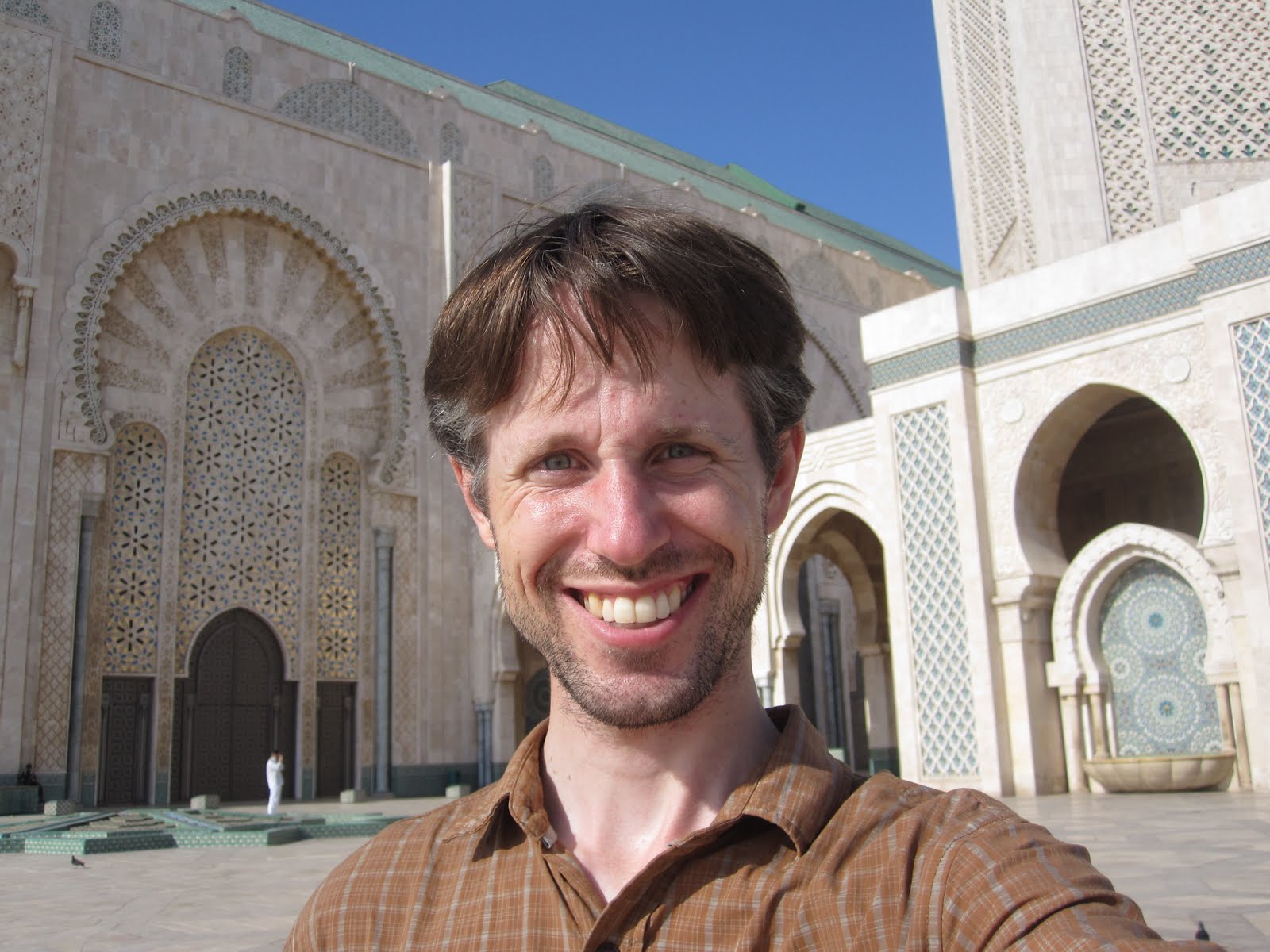
The Economist which I read from time to time sees itself as taking part in a severe contest between intelligence, which presses forward, and an unworthy, timid ignorance obstructing our progress. I am afraid of being irrational. Is grace possible? When I arrived in Casablanca that evening and went to the Hassan II Mosque I felt like it just might be.


Monday, June 14, 2010

Understanding the word

One thing that I thought a lot about while I was traveling was religion. Both in Nepal and Morocco religious expression felt more public than it does here in the States. In Nepal this took a number of different forms. In the hills in the central and southern parts of the country, i.e., not in the Buddhist Himalaya of the north, I would see people with assorted red tikas on their forehead every day. Often this meant that they had gone to a temple that morning. In Kathmandu, in particular, there were little temples and shrines on nearly every block it felt, with well loved idols covered in tika powder, marigolds and such. In Hetauda, the women of the family that lives downstairs from Tiffany would go out into the front yard every evening to light candles and ring bells at their small altar.

In Morocco, of course, there was the call to prayer five times a day: Four in the morning, noon, five in the afternoon, and eight and ten o'clock at night. I would often see men--rarely women--going into or coming out of a local mosque shortly after the call. One thing that was particularly striking to me about Morocco was the form the religious art takes in that part of the world.

First off, it was very photogenic. Here are a couple examples of beautiful lighting in a couple of shrines in Meknès, the first city I went to in Morocco.


I quickly noticed that the art is very focused on the written word. Here are a couple of examples, one from a shrine in Meknès and another from a medersa or (religious) school in Fez, where I spent my last couple days in the country.


Of course, there is more to the art than just the written word. There is clearly quite a bit of tile work, involving various geometrical patterns and the occasional floral motif, as well. In the medina or old city in Fez there are dozens of fountains that act as public water sources. They are often quite beautifully embellished with lovely tile work. Here is a nice example.


I went to the ancient Roman city of Volubilis, which is known for its beautiful in-situ mosaics. I felt like I could see some continuity between the ancient Roman art and the more-recent Islamic art. Muslims, however, in stark contrast to the Romans never depict humans or animals in their art for fear of idolatry.


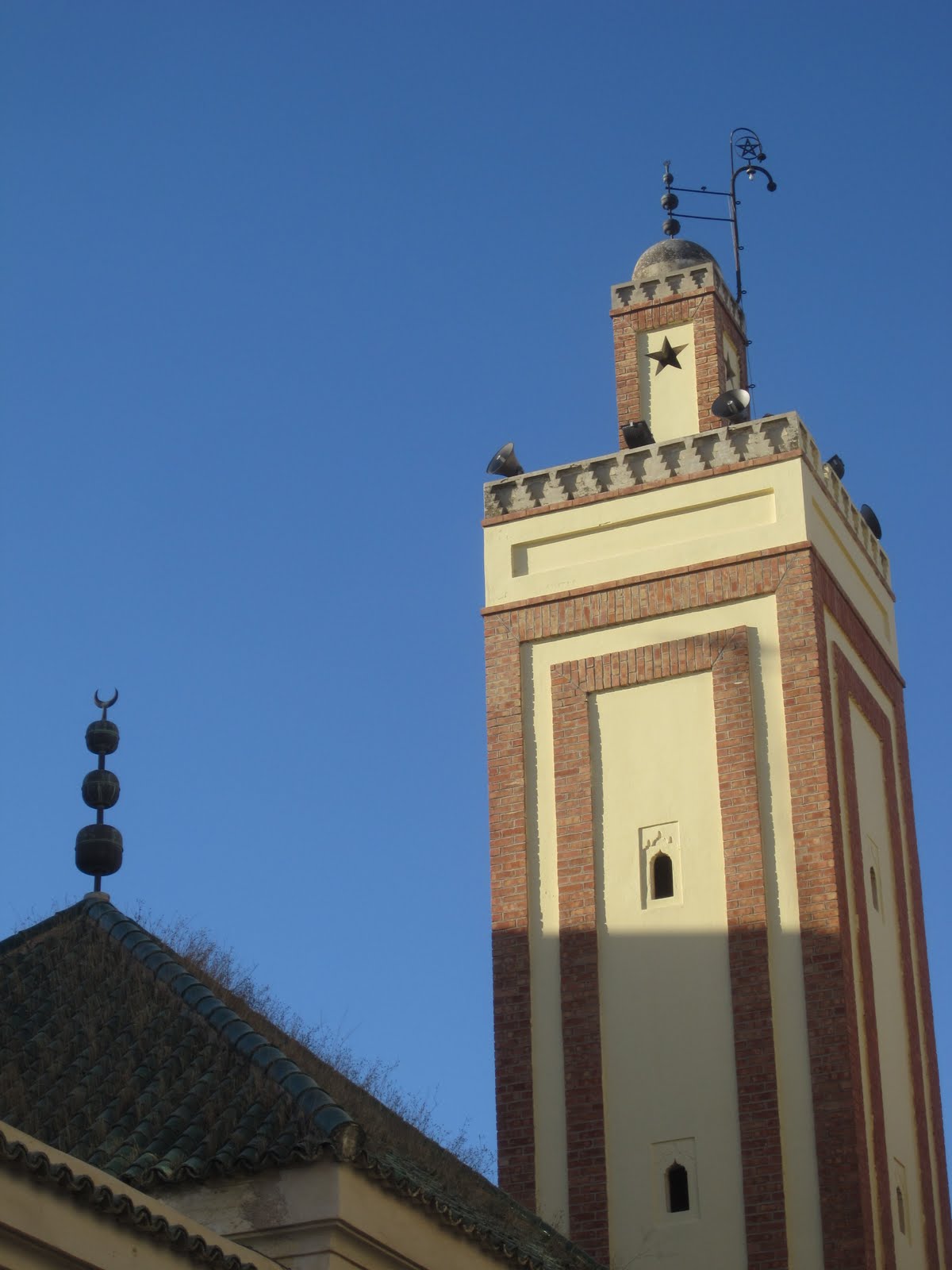
And finally, Islamic art and architecture does occasionally incorporate other symbols, especially the crescent moon, but also in Morocco, in particular, the pentagram, which is an important symbol there--a bit more on that in a future post. Here you see both of these symbols in a mosque in Fez.


In the end, for me, though, most striking was the role of the written word in Moroccan religious art. Walking down the alleyways of the medina in Fez, I saw all kinds of framed writings and men carving Koranic verse.


And again, this was in such stark contrast to Nepal, where religious art and expression is so much more physical, visceral, base. In Morocco it felt austere and abstract.

What's the point? I wrote in a previous post that one reason why I choose to travel--to Morocco, in particular, but more broadly, as well--is to cultivate within myself more compassion, including--perhaps especially--for people who look or think differently from me. Another aspect of this, another reason I choose to travel I am realizing, is to understand myself. Who am I? One way I can tackle this question is by trying to understand who I am not. What does it mean to be a Portlander, an Oregonian, an American? What does it mean to be a Moroccan? Any insights I can gain into the latter may help me to answer the former.

It is straightforward enough to read a no smoking sign written in a foreign script.


Harder to understand the meaning of a place you may not enter. (Non-Muslims are forbidden from entering mosques in Morocco.)


These words that I am so fascinated with in Islamic art, what do they say? Of course, they are verse from the holy Koran, and I imagine they must speak to good and evil, right and wrong, believers and infidels. I bet they allude to stories, hundreds or even thousands of years old. The foreign or exotic holds such an appeal for me, as no doubt it does for many people, the world over. But to what extent is this infatuation due to ignorance, naïveté? I have this belief that I may be able to gain a better understanding of myself, of my place in the world by reflecting on these foreign people and places, these things that are not part of my (European, Christian) heritage. What if these foreign, exotic words spoke about intolerance, bigotry? Would I be so enamored still? Do I have higher standards for words I can understand, English words, than for these words that I cannot read, that do nothing more than evoke a feeling in me?

The other day I started reading a short history of the Balkans, where my friend Iva, who I am staying with while I transition back into the real world, grew up. It's fascinating to read about this crossroads between East and West, between Christendom and the Muslim World. But this is such an academic approach to this question. Somehow I crave this in-you-bones level of knowing. But I know I will never know the Balkans--or Morocco, or Nepal--in that way, the way that someone who grew up there, with those sounds and smells and tastes and stories knows it, unless perhaps I devoted my entire life to that quixotic pursuit. Will Iva ever know the USA as I do? What if she is married to an American and lives here for another 60 years? And if she did succeed in gaining this understanding, would that benefit her in any way? Would she somehow be more satisfied or fulfilled in her life? That is my (rhetorical) question of the day.

Friday, May 28, 2010

My first YouTube video

I just posted my first-ever video to YouTube. This was the view from the rooftop terrace of my hotel in Moulay Idriss. Really happy about my choice to go to this small town...
As we went we listened


We decided to take the bus this morning, a hundred Moroccans and me
From Moulay Idriss, one of the country's most holy cities
To Meknès
To Bab el-Khemis, the medina's western gate

We passed through olive orchards
By roadside agave and artichokes
By carob and cacti
It felt like rain


As we approached the city
The people standing in the aisle had to duck
Lest the police notice
The overcrowded bus

And as we went we listened
To the voice of the man on the radio
As he sang sacred verse
From the holy Koran

Tuesday, May 25, 2010

Rehumanization

A few people have asked me why I am in Morocco as a part of my current travels. I have quoted various superlatives involving Fez; biggest this, oldest that. But that does not really get to the heart of why I am here. And so the question has stayed with me. And really, it goes even deeper than that. Why travel at all, regardless of destination? This is a question that haunts me. By traveling am I being selfish, wasteful?

I flew into Casablanca yesterday afternoon from Geneva. I hopped on a train at the airport and ended up in Meknès, albeit late--like midnight late. But no worries, Hotel Majestic was right around the corner and exactly what I needed.

This morning I walked about 20 minutes over to the old town, the medina, from the new town, the ville nouvelle, where I am staying. I proceeded to get lost, literally, in the various markets or souqs of the medina--and a couple of times, at that. The souqs are quite a sight--and smell and sound and taste! Vegetables, spices, fish, meat, clothes, shoes, leather products, wood products, silver, etc. Each with its own collection of a few or a lot of nearly identical little shops. Feels like how shopping used to be, you know? All open air, little signage. No branding. Not corporate. Had shawarma, a meat and veggie sandwich, in a little place on the main square.

By this evening I had made my way to a nice open green space back in the ville nouvelle, just a few blocks from my hotel. So many people out for a post-dinner walk! I feel like I have seen this before, say in Valladolid, Mexico or Gresham, Oregon--could be anywhere, and that is starting to get to the point.

Seeing all of these people, just out enjoying the evening... couples, families, individuals; young, mid-life, old; traditional, progressive; all kinds. I was just walking around, quietly taking in the scene, when a couple of girls carrying a heavy bag walked by me. The must have been about ten years old. Their load was clearly heavy, and they started to argue a bit about it. In Arabic, of course. That was when it hit me. Rehumanization.

(The sun just set. The fairly modern guy running the internet cafe I am in turned off the cheesy French music that had been playing. The call to prayer echos in through the windows.)

That is at least part of the reason that I choose to spend some of my precious time and money on travel. The word just occurred to me hearing these girls speak, the guttural and emphatic consonants, the glottal stops of their Afroasiatic language. I do not know whether it is a real word. I certainly had not heard it before, although a cursory google search reveals that others have found a use for it, as well, e.g., here.

I feel vulnerable when I travel. I make mistakes. I do not understand things--a lot of things! It is a feeling. It is emotional. It helps me to learn to have empathy. What does it mean to be on the outside?

Moreover, I see more of the nuance and complexity of the world. Of course the world is complex you say from the comfort of your home. But it is something else entirely to feel that complexity, to smell it, to taste it. Television cannot do that. Google cannot do that. Wikipedia cannot do that.

There is such a drive to categorize, to quantify. To place people in nice, clean boxes. To stereotype. To turn people into others. But we are all human. We all feel. We all matter. We are all part of us.

That is what I was reminded of this beautiful evening in Meknès. Rehumanization. A good of a reason as any to take a trip to Morocco.

Sunday, May 23, 2010

Person, place, thing

This morning, now that the Kolbs have gone, I could take time to write about Genève and around, about places and things. I could focus my attention on facts and figures. On hyperlinks.


But that would miss the point, wouldn't it? Really, it's about people and relationships. About learning from one another and sharing. About conversing and lending a helping hand. That's where I'll try to focus my attention today.


By now the Kolbs, grandparents and all, are well on their way to Italy. Tomorrow, with any luck I'll be spending the night in Meknès. But for now it is simply quiet. A bright sunshiny day.

I can think back on this last week spent with the Kolbs. The beautiful singing Ruthie, the kids and I heard in John Calvin's cathedral.


The picnic lunch we all shared in a vineyard outside of Russin.


Of course, there was alone time, too. Appreciating how international of a place Geneva is. Home of the WHO, UNHCR, IFRC, etc. (The people from all over the world, speaking languages from Swahili to Vietnamese, dressed in their suites and professional-looking dresses, riding the buses into town to go to work at these places were such a stark contrast to the suped-up UN trucks I saw all over Nepal, in Kathmandu and on half-built roads in the countryside alike.)


Appreciating the Swiss sense of order on roads and hiking trails in the Jura Mountains. (Note: This is not technically an Alpine meadow.)


Simply appreciating being in a European city like Geneva, lions and all...


I've been traveling for nearly two months now. That's a while! It has given me an opportunity to think about my priorities, my values. I can get caught up in details, in information, in trivia. But really, so much of this journey has been about spending time with people: friends, new and old.

I'll fly to Morocco tomorrow afternoon, and take a train into the interior. I'll have a little over a week to eat tajines, practice my Moroccan Arabic, take in the call to prayer. (Incidentally, you can listen to the call to prayer, for example, here. And please don't misunderstand my sharing of this. I'm not Muslim or really even particularly religious. But something about hearing the call to prayer just gets me.)

And in a way I feel like this trip is coming to an end. Before I know it I'll be back home, with good people, yes. But it has been so wonderful to spend this time with my friends who are living for a time in Asia and Europe. That is something I'm truly grateful for.

Monday, May 17, 2010

Color in Nepal

One thing I really noticed during my time in Nepal was how colorful everything was, and I have a few examples I'd like to share. A picture says a thousand words and all that.

In between the two treks I went on, in Langtang and the Everest region, I spent time in Kathmandu and Hetauda, a medium-sized town in the south where Tiffany is living and volunteering. I especially noticed color in these more southern, more Hindu places. The more Buddhist north was somewhat colorful, as well, I suppose, but not nearly to the same extent.

For example, this was a very common scene walking into town from Tiffany's apartment.


I love the saris and kurta surwals. But maybe even more than the clothes, I really appreciated the judicious use of the umbrella for blocking the sun in Hetauda. This was the most southern and therefore the hottest part of the country that I visited, and the umbrella usage was unlike anything I saw anywhere else. Very nice.

Another colorful part of Hetauda and the surrounding region was all of the red flowering trees. This photo starts to give you a sense, although it doesn't quite capture just how brilliant these trees are this time of year.


One my last Tata Sumo ride back up to Kathmandu from Hetauda the day before I left Nepal--which was just a few days ago, crazy--we stopped at the Dakshinkali Temple just a few kilometers before reaching Kathmandu. Incidentally, the goddess, Kali, and Hinduism more broadly, is so interesting to me these days. I know quite a bit more than I did before my trip to Nepal. I guess at this point it pretty much just blows my mind. So for example, I honestly don't know what the goddess, Kali, is all about. From what I've read and some of what I saw in Nepal she seems like a pretty dark character. But I've heard and read things, too, about her somehow being viewed as a mother goddess. Who knows? Anyhow, when we stopped there by the temple to change a flat tire, a young man came over and offered everyone in our Tata Sumo this tray of tika powder, etc.


All of the Hindus in the Tata Sumo, i.e., everyone but me, took a healthy portion of the tika powder on one of the flowers and applied it judiciously to their forehead. I believe it must have been some kind of minor festival of some sort, as I had never seen anything along these lines on any of my previous Tata Sumo rides past this temple.

In Kathmandu there was quite a bit of color, in particular at Pashupatinath, which is one of the holiest if not the holiest Hindu site in Nepal. Pashupatinath, by the way, is a temple of Pashupati, a particular version of Shiva associated with animals. As you walk in towards the temple complex, you are bombarded with stalls full of color. There are the beautiful marigolds, which would appear to play an important role in Hinduism that I don't quite understand.


There was the tika powder, and not only the most common reds, oranges, and yellows, but other colors as well.


And there were the widows, the female sadhus, or Hindu holy people, who hang out at the temple.


So much beautiful color all over the country. Really, this is just the smallest little taste of what I saw. One of the most important things that is missing is the clothing that women wear and the tikas that men, women, and children so commonly have. Hard to get photos of people sometimes, I suppose...

And now as I sit in Jeff and Ruthie's place outside of Geneva, the color is starting to fade. But I know Nepal is just as colorful as the day I left. I don't see that changing anytime soon.

Thursday, May 13, 2010

Symbols of Hetauda

I only have a few hours left in Nepal, but I still have lots of thoughts about all that I have seen here over the past six weeks. So much to process.

One thing that I've been thinking about a lot is symbols. I just did a quick google search. A couple interesting sites popped up that seem to merit further investigation, symbols.com and symbols.net. Also, here is the obligatory Wikipedia article.

Walking around Hetauda, where my good friend, Tiffany, is a VSO volunteer working with COSAN, a local Nepali NGO, I felt constantly bombarded by symbols. Really, this was the case all over the Nepal, but it seemed especially so in Hetauda.

I'll start simple--relatively. I saw this cross on the gate to Tiffany's neighbor's home.


They are Christian. They sing religious songs (in Nepali) in the evening, while other neighbors play guitar and sing secular songs or light candles and incense as a form of puja. By the way, according to this Wikipedia article, less than one percent of Nepalis are Christian.

A symbol that is perhaps a bit more common than the cross in Hetauda--and certainly much more common in Nepal as a whole--is the communist hammer and sickle. For example, I saw this flag hanging over Main Road in Hetauda a couple days ago.


I think it's kind of nice that there is a tractor driving down the street in the photo, as well. Kind of completes it for me. I'll write a bit more about Nepali politics later, but for now I'll just say that there are two different--and opposing--communist parties in Nepal, the Communist Party of Nepal (Unified Marxist Leninist) and the Unified Communist Party of Nepal (Maoist). Here are their official web sites, CPN-UML and UCPN (Maoist). Interestingly, UCPN (Maoist) has a facebook page, as well.

A couple weeks ago I went up to the mountain with an Israeli guy named Moses or Moshe in Hebrew. Much more about this later. For now I just want to say that both he and I noticed hexagrams all over the place up there--think Star of David. It would seem that--perhaps among other meanings--it is associated with education in this part of the world. Here is an example of one on the gate to a school--on School Road coincidentally enough--not too far from Tiffany's home in Hetauda.


By the way, I just asked the nice Nepali guy sitting next to me in the internet cafe what is written--in Devanagari script--in and around this particular hexagram. He said the bit in the middle is a year, the year 2016, in particular. Recall that Nepal uses Bikram Samwat calendar, and the current year here is 2067. His guess was that that was when the school would have been build, i.e., 51 years ago. The word in the top right is "golden" so it would make sense that this nice gate would have been made for the school's golden anniversary. The yellow word towards the bottom is Hetauda, the town where the school is located. The rest of the symbols seem to indicate the name of the school, but without more context it was hard for this fellow to decipher with certainty. Just an interesting little aside...

In the Hindu world, Om is a very important symbol. In fact, it's about the only symbol in Devanagari that I can recognize. You see it all over the place, for example on the sign above a little shop near Tiffany's work.


The god in the painting is Shiva, one of the most important gods in Hinduism. His weapon is the trident or trisul. Here is one of many, many trisuls to be seen in and around Hetauda.


By the way, up in the Buddhist part of the country Padmasambhava, a.k.a. Guru Rinpoche, is often seen holding a trisul. My trekking partner, Moses, thought of Lucifer every time he saw this particular symbol.

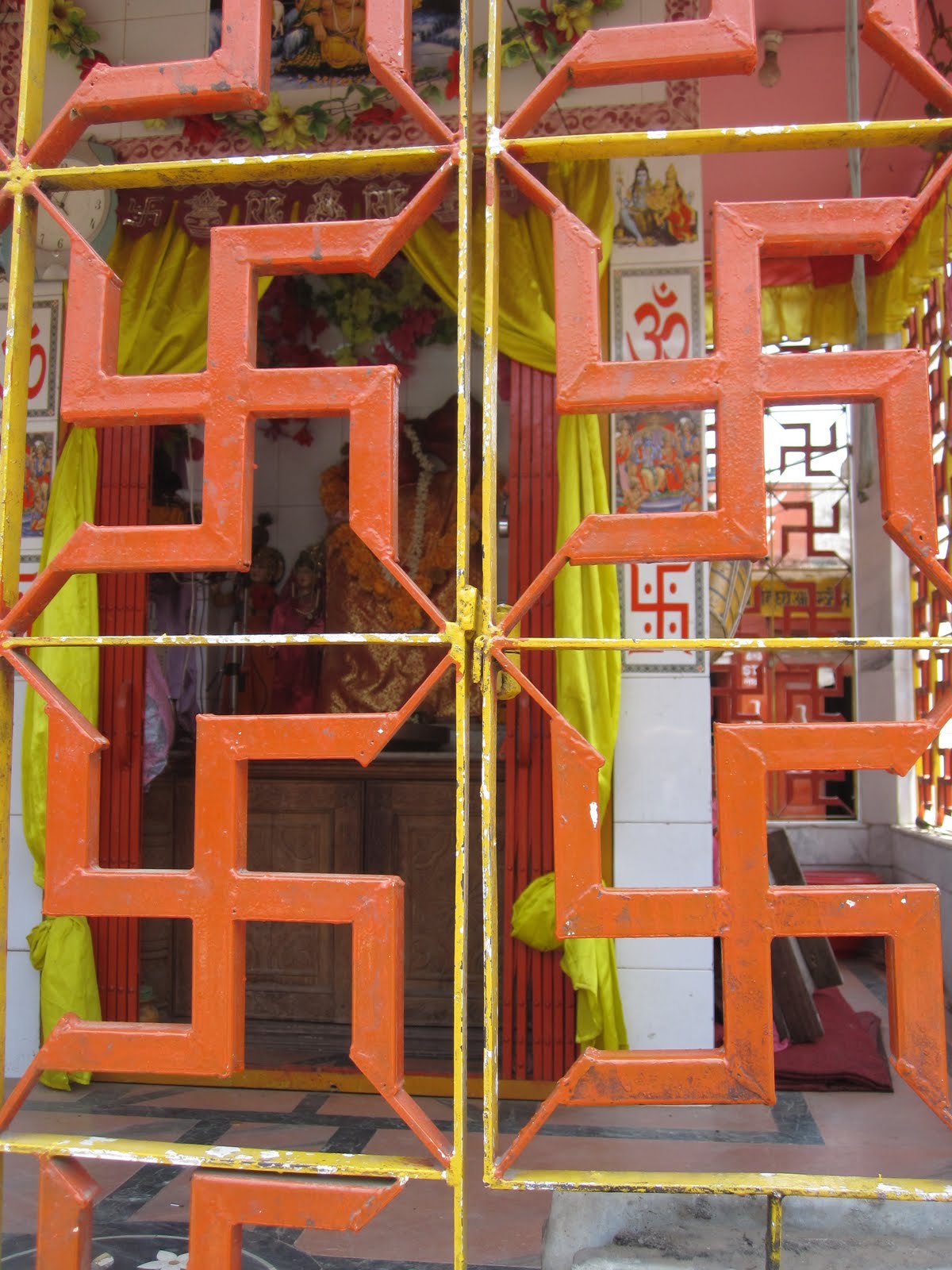
Finally, the swastika, perhaps the most challenging--for Westerners--symbol of the region. Here is one of many examples in and around Hetauda, from a small temple on Main Road.


Note the Om in there, as well. It was particularly hard walking around up in the mountains with Moses seeing so many swastikas, tatooed on peoples' hands, on carpets, etc.

What's the point? I guess it's twofold. One, symbols are very common in Nepal. And really, I bet they are pretty common at home, too. It is probably just that I notice them more being in a foreign land. Two, and much more importantly, I think, the meaning of a symbol depends on context. Take the hexagram or the swastika, for example. For my whole life those two symbols have held very strong and very specific meanings. In this part of the world, though, they have utterly, completely different connotations. It really just takes some time to integrate that. It's one thing for someone to say that or to think it abstractly, and another all together to walk down the street and see a holy temple covered in swastikas. Makes you think. Makes me think, anyway.