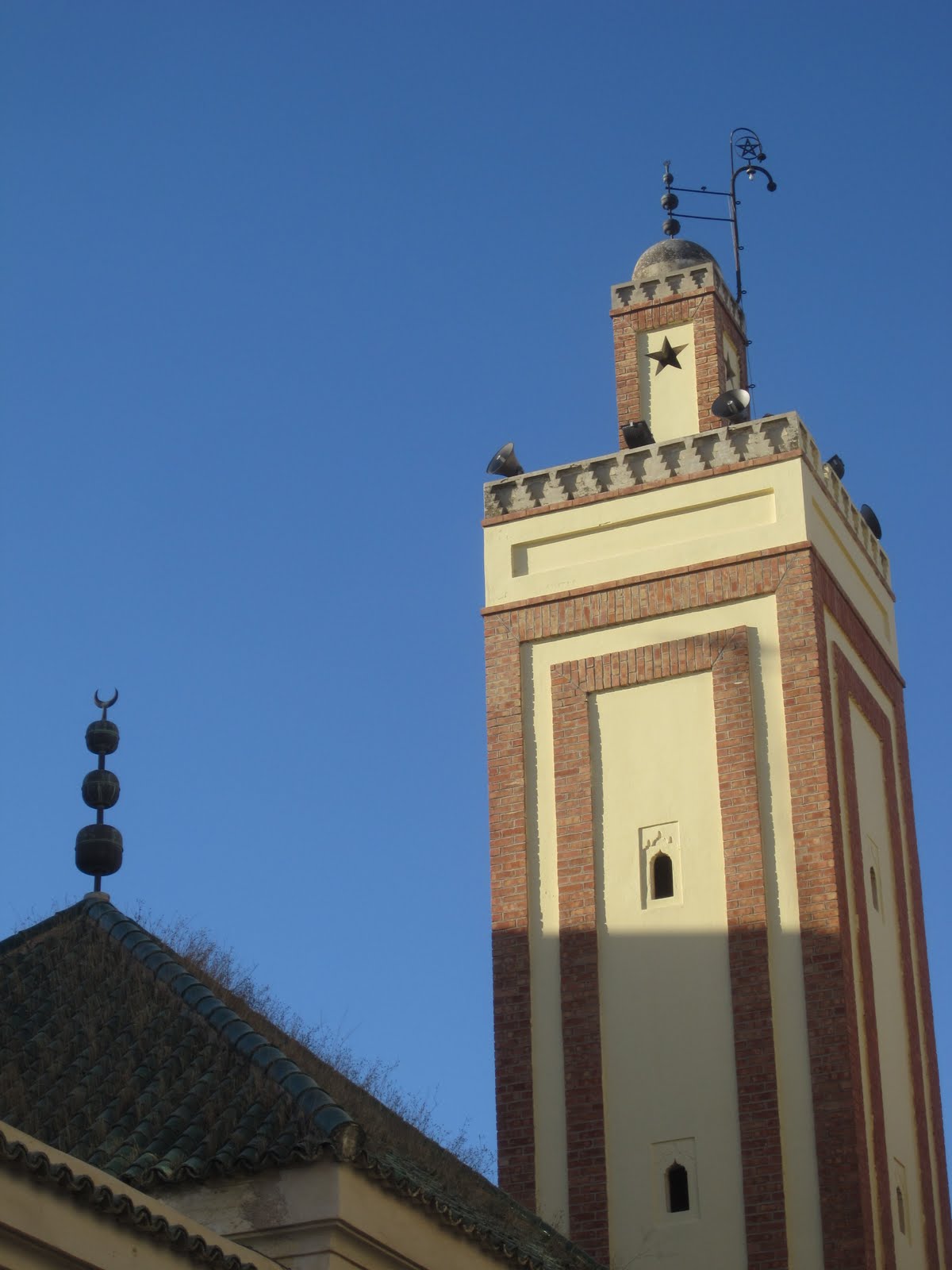
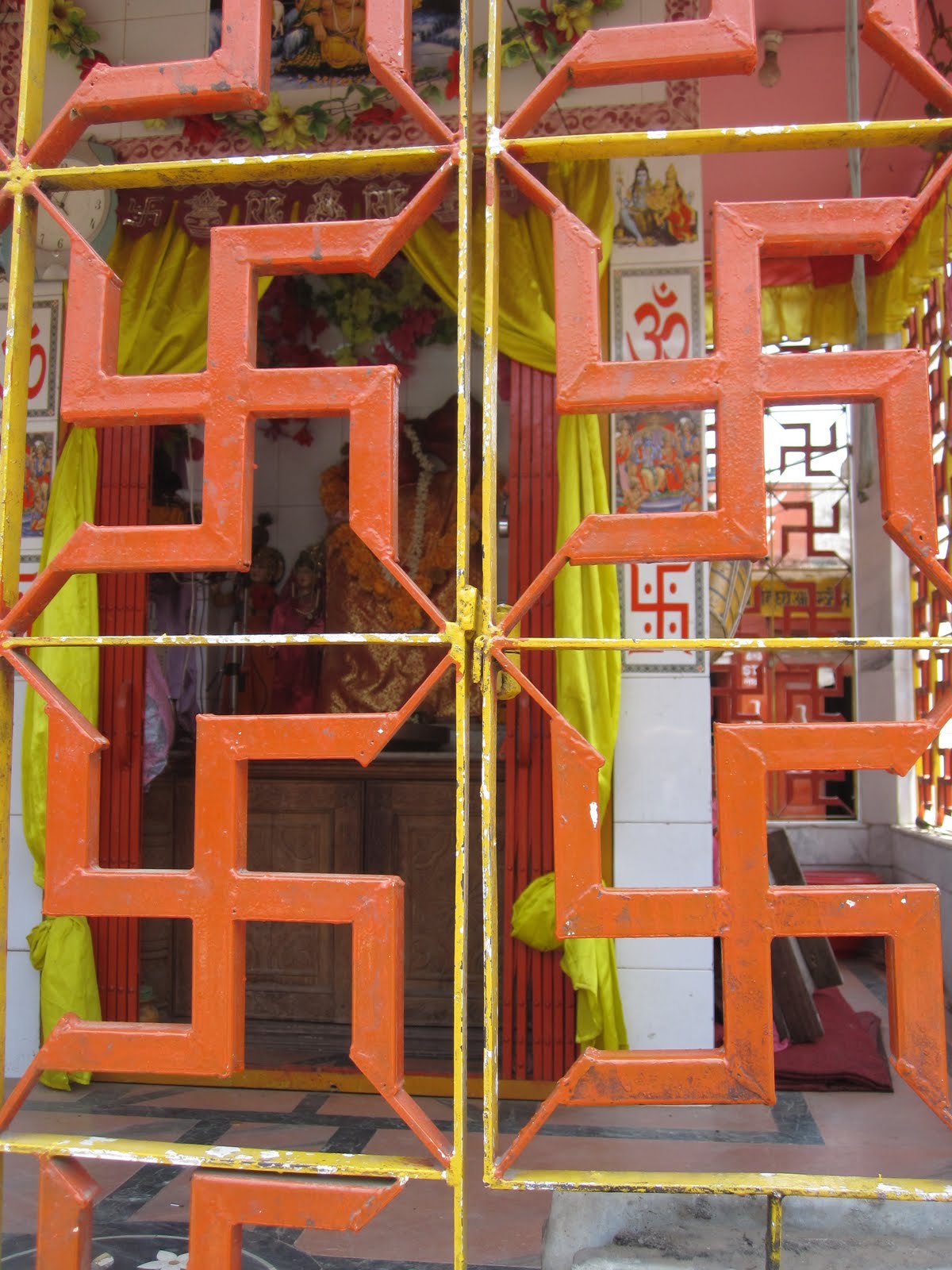
A few days ago I wrote a post about some of the various meanings of the symbol of the swastika in the countries I visited over the last few months: Nepal, Switzerland and Morocco. In particular, it was upsetting to see it graffitied on bathroom stalls and old city walls, a clear symbol of hate and intolerance. I continued to mull it over for a while, and eventually the word xenophilia came to mind. I didn't know whether it is actually a real word or not, but I kind of liked the sound of it. The opposite of xenophobia, I though, as from my physics days I remember hydrophilia--the property of a material or compound having an affinity to water--being the opposite of hydrophobia--a lack of such an affinity.
So I did what any good citizen of the 21st century would do: I googled it. It turns out that xenophilia is indeed a word, although xenophily may be a more common synonym. And it is indeed the opposite of xenophobia. For better or worse, though, the Wikipedia article on xenophily is negative and actually a bit disturbing, frankly. The negative part is a reference to George Washington's 1796 Farewell Address, where among other things he warned against potentially negative consequences of being infatuated with a foreign nation. The disturbing bit is summed up nicely in the opening paragraph: ...a person may date someone of another race not because they like them as people but specifically because they are different. That's enough to convince me that the meaning of xenophilia is more loaded than my initially naïve notion of simply the opposite of xenophobia without the negative--and potentially sexual--connotation. Perhaps in the end the less exotic tolerance was the word I was looking for. Fair enough.
In addition to the obligatory Wikipedia article, my cursory search of xenophilia led me to this post from a few years ago on the conservative blog Faultline USA. On one level I can sympathize with the concerns of this conservative blogger--and George Washington, for that matter. I agree that attraction to foreignness for its own sake is at least wrong-minded and potentially even dangerous. However, intolerance, bigotry, xenophobia or worse, outright hatred, I cannot tolerate.
On the last night of my 18 day trek in the Everest region, my fellow trekkers and I went out for a drink at the Irish Pub in the Sherpa village of Lukla, where the airstrip is that we would use the next morning to fly back to Kathmandu. By the way, no, that is not a real Starbucks--copyright is not respected in this part of the world--and yes, those are prayer wheels on the entrance to the Irish Pub.
Left to right here we have Emma and Joe, English veterinarians gradually making their way home after living and working for about a year as large animal vets in rural New Zealand, Bruce, an accomplished mountaineer and pulmonologist from southern California, Moses--or Moshe in Hebrew--a retired lieutenant colonel in the Israeli army of Moroccan descent. The television in the Irish Pub in Lukla was tuned to the English version of the Arabic-language news network Al Jazeera. Sitting there watching the news with my new friends, I realized that I felt a little uncomfortable. Was I being un-American by watching this Qatari news station? I asked Moses his opinion of Al Jazeera. I don't remember his exact words, but the essence was that this 24 year veteran of the Israeli army respects the channel, that he trusts their reporting. Why did that surprise me? Maybe the nuance, the reminder of the world's complexities. For what it's worth, here is Al Jazeera's code of ethics. Reasonable enough.
There were a number of different stores on the news that night, but I believe it was something about the recent constitutional amendment in Switzerland banning the construction of new minarets in the country that sparked a conversation relevant to this post. We started talking about the issue of Muslims in Europe, assimilation and such. Emma, in particular, seemed frustrated by the view of some in the UK that the Muslim community there should be allowed to implement Islamic Sharia law. What occurred to me is that perhaps one of the only things that a liberal, tolerant society like the UK should not and cannot tolerate is intolerance itself. So to the extent that Sharia contains elements of intolerance it has no place in the UK. Of course, that is an oversimplification, but to me, anyway, it feels like a decent starting point for thinking about this complex issue.
I appreciate the criticism of the conservative blogger. Reflecting on these words helps me to clarify my own values. If I am completely honest, there is a part of me that is attracted to this foreignness for its own sake. And if I want to be especially self-critical, I could even go as far as to call it a naïve, base infatuation. At times it may be just that.
But if I take a step back, I can paint my interests in a more positive light, as well. Thinking back over my writings in this blog over the last few months, I realize that a good deal of it has been about my quest to find a middle way between xenophobia--an irrational and unwarranted fear of the foreign--on the one hand and xenophilia--an irrational and potentially dangerous infatuation with the foreign--on the other. My hope is that with a combination of intuition and analysis I can find this middle path of tolerance between these unattractive extremes.
Reflections on religion, symbols and tolerance inspired by a two-month journey through Nepal, Switzerland and Morocco.
Tracking Code
Showing posts with label symbols. Show all posts
Sunday, June 20, 2010
Thursday, June 17, 2010
Vexillology in al-Mamlaka al-Maghribiya
Sometimes I can't help myself. This morning, for example, I learned that vexillology is the scholarly study of flags. This Flags of the World site has all kinds of good information about flags, including a fun clickable map! Here is the page on the Kingdom of Morocco, or in Arabic al-Mamlaka al-Maghribiya.
This came up because I was thinking about symbols again. I mentioned in an earlier post that the pentagram is an important symbol in Morocco. If interested, you can read more about it, for example on the flag site I mentioned above.
As in most countries I suppose, the flag itself is a fairly common site in Morocco. Here it is, for example, outside of the Royal Palace in Fez.
There were often pentagrams in mosques, as well. Here is one in Fez--taken from through the door, of course, as I was not allowed to enter as a non-Muslim.
I think that may satisfy my fascination with symbols for a while. I suppose I get it that they really do mean different things to different people in different places and times. Fair enough.
I anticipate that my next few posts will be about Fez, which was my favorite Moroccan city, and my treks in the Himalaya, which were the most spectacular parts of my trip. Stay tuned.
This came up because I was thinking about symbols again. I mentioned in an earlier post that the pentagram is an important symbol in Morocco. If interested, you can read more about it, for example on the flag site I mentioned above.
As in most countries I suppose, the flag itself is a fairly common site in Morocco. Here it is, for example, outside of the Royal Palace in Fez.
There were often pentagrams in mosques, as well. Here is one in Fez--taken from through the door, of course, as I was not allowed to enter as a non-Muslim.
I think that may satisfy my fascination with symbols for a while. I suppose I get it that they really do mean different things to different people in different places and times. Fair enough.
I anticipate that my next few posts will be about Fez, which was my favorite Moroccan city, and my treks in the Himalaya, which were the most spectacular parts of my trip. Stay tuned.
Wednesday, June 16, 2010
The Diamond of Transcendent Wisdom
A few days ago I was reading an article in National Geographic about Buddhist art and writings at a particular holy site along the ancient Silk Road in northwest China. I was particularly struck by a photograph of a Buddhist manuscript called the Diamond Sutra, which was printed in 868 and is apparently the oldest example of a printed and dated book on earth. It was rediscovered in 1907 and is currently housed in the British Library, which has a pretty fascinating site on this text and much more.
Here is the image from the British Library site. (I hope this usage isn't a copyright violation...)
This is a beautiful image, all the more so because of its incredible age. But what I was most struck by is the swastika on the chest of the Buddha figure in the middle of the image. Take a closer look. Isn't that amazing? So incongruous to modern, Western eyes. It is for me anyway.
I've already discussed my fascination with the varied interpretations of symbols throughout time and place, for example here. Today, I would mainly like to share a few relevant photos from my trip.
Towards the end of my time in Hetauda, Nepal where my friend Tiffany is living and volunteering, the powers that be started to pave Bhairab Road near her apartment. Here is the roller. Note the swastikas.
Walking down the street in Hetauda, Tiffany and I noticed these bricks.
So here's the thing about the swastika in Nepal. Yes, I admit that I am particularly fascinated by it, but it really was fairly ubiquitous. I'm not making this up.
What does it mean to Nepalis? Why is it so common? It seems to be an auspicious symbol thought to bring good luck. Here is a short description of the meaning of the swastika in Hinduism.
Before going to Nepal I had no idea that it represented anything other than racism and intolerance. I suppose perhaps I knew that it was also used by certain Native American tribes, but I had no idea that it had been used for thousands of years throughout Europe and Asia.
I was somewhat surprised--and disappointed--to see it again in a bathroom in a small town in Switzerland, where of course it had an entirely different meaning from the one I had just learned about in Nepal.
I was also unpleasantly surprised to see it in the otherwise beautiful, blue town of Chefchaouen, Morocco where no doubt it was once again meant to symbolize intolerance.
Isn't that wild? It blows me away that the same symbol can hold such vastly different meanings to different peoples. The world is big. And complex. And I wouldn't have it any other way.
Here is the image from the British Library site. (I hope this usage isn't a copyright violation...)
This is a beautiful image, all the more so because of its incredible age. But what I was most struck by is the swastika on the chest of the Buddha figure in the middle of the image. Take a closer look. Isn't that amazing? So incongruous to modern, Western eyes. It is for me anyway.
I've already discussed my fascination with the varied interpretations of symbols throughout time and place, for example here. Today, I would mainly like to share a few relevant photos from my trip.
Towards the end of my time in Hetauda, Nepal where my friend Tiffany is living and volunteering, the powers that be started to pave Bhairab Road near her apartment. Here is the roller. Note the swastikas.
Walking down the street in Hetauda, Tiffany and I noticed these bricks.
So here's the thing about the swastika in Nepal. Yes, I admit that I am particularly fascinated by it, but it really was fairly ubiquitous. I'm not making this up.
What does it mean to Nepalis? Why is it so common? It seems to be an auspicious symbol thought to bring good luck. Here is a short description of the meaning of the swastika in Hinduism.
Before going to Nepal I had no idea that it represented anything other than racism and intolerance. I suppose perhaps I knew that it was also used by certain Native American tribes, but I had no idea that it had been used for thousands of years throughout Europe and Asia.
I was somewhat surprised--and disappointed--to see it again in a bathroom in a small town in Switzerland, where of course it had an entirely different meaning from the one I had just learned about in Nepal.
I was also unpleasantly surprised to see it in the otherwise beautiful, blue town of Chefchaouen, Morocco where no doubt it was once again meant to symbolize intolerance.
Isn't that wild? It blows me away that the same symbol can hold such vastly different meanings to different peoples. The world is big. And complex. And I wouldn't have it any other way.
Monday, June 14, 2010
Understanding the word
One thing that I thought a lot about while I was traveling was religion. Both in Nepal and Morocco religious expression felt more public than it does here in the States. In Nepal this took a number of different forms. In the hills in the central and southern parts of the country, i.e., not in the Buddhist Himalaya of the north, I would see people with assorted red tikas on their forehead every day. Often this meant that they had gone to a temple that morning. In Kathmandu, in particular, there were little temples and shrines on nearly every block it felt, with well loved idols covered in tika powder, marigolds and such. In Hetauda, the women of the family that lives downstairs from Tiffany would go out into the front yard every evening to light candles and ring bells at their small altar.
In Morocco, of course, there was the call to prayer five times a day: Four in the morning, noon, five in the afternoon, and eight and ten o'clock at night. I would often see men--rarely women--going into or coming out of a local mosque shortly after the call. One thing that was particularly striking to me about Morocco was the form the religious art takes in that part of the world.
First off, it was very photogenic. Here are a couple examples of beautiful lighting in a couple of shrines in Meknès, the first city I went to in Morocco.
I quickly noticed that the art is very focused on the written word. Here are a couple of examples, one from a shrine in Meknès and another from a medersa or (religious) school in Fez, where I spent my last couple days in the country.
Of course, there is more to the art than just the written word. There is clearly quite a bit of tile work, involving various geometrical patterns and the occasional floral motif, as well. In the medina or old city in Fez there are dozens of fountains that act as public water sources. They are often quite beautifully embellished with lovely tile work. Here is a nice example.
I went to the ancient Roman city of Volubilis, which is known for its beautiful in-situ mosaics. I felt like I could see some continuity between the ancient Roman art and the more-recent Islamic art. Muslims, however, in stark contrast to the Romans never depict humans or animals in their art for fear of idolatry.
And finally, Islamic art and architecture does occasionally incorporate other symbols, especially the crescent moon, but also in Morocco, in particular, the pentagram, which is an important symbol there--a bit more on that in a future post. Here you see both of these symbols in a mosque in Fez.
In the end, for me, though, most striking was the role of the written word in Moroccan religious art. Walking down the alleyways of the medina in Fez, I saw all kinds of framed writings and men carving Koranic verse.
And again, this was in such stark contrast to Nepal, where religious art and expression is so much more physical, visceral, base. In Morocco it felt austere and abstract.
What's the point? I wrote in a previous post that one reason why I choose to travel--to Morocco, in particular, but more broadly, as well--is to cultivate within myself more compassion, including--perhaps especially--for people who look or think differently from me. Another aspect of this, another reason I choose to travel I am realizing, is to understand myself. Who am I? One way I can tackle this question is by trying to understand who I am not. What does it mean to be a Portlander, an Oregonian, an American? What does it mean to be a Moroccan? Any insights I can gain into the latter may help me to answer the former.
It is straightforward enough to read a no smoking sign written in a foreign script.
Harder to understand the meaning of a place you may not enter. (Non-Muslims are forbidden from entering mosques in Morocco.)
These words that I am so fascinated with in Islamic art, what do they say? Of course, they are verse from the holy Koran, and I imagine they must speak to good and evil, right and wrong, believers and infidels. I bet they allude to stories, hundreds or even thousands of years old. The foreign or exotic holds such an appeal for me, as no doubt it does for many people, the world over. But to what extent is this infatuation due to ignorance, naïveté? I have this belief that I may be able to gain a better understanding of myself, of my place in the world by reflecting on these foreign people and places, these things that are not part of my (European, Christian) heritage. What if these foreign, exotic words spoke about intolerance, bigotry? Would I be so enamored still? Do I have higher standards for words I can understand, English words, than for these words that I cannot read, that do nothing more than evoke a feeling in me?
The other day I started reading a short history of the Balkans, where my friend Iva, who I am staying with while I transition back into the real world, grew up. It's fascinating to read about this crossroads between East and West, between Christendom and the Muslim World. But this is such an academic approach to this question. Somehow I crave this in-you-bones level of knowing. But I know I will never know the Balkans--or Morocco, or Nepal--in that way, the way that someone who grew up there, with those sounds and smells and tastes and stories knows it, unless perhaps I devoted my entire life to that quixotic pursuit. Will Iva ever know the USA as I do? What if she is married to an American and lives here for another 60 years? And if she did succeed in gaining this understanding, would that benefit her in any way? Would she somehow be more satisfied or fulfilled in her life? That is my (rhetorical) question of the day.
In Morocco, of course, there was the call to prayer five times a day: Four in the morning, noon, five in the afternoon, and eight and ten o'clock at night. I would often see men--rarely women--going into or coming out of a local mosque shortly after the call. One thing that was particularly striking to me about Morocco was the form the religious art takes in that part of the world.
First off, it was very photogenic. Here are a couple examples of beautiful lighting in a couple of shrines in Meknès, the first city I went to in Morocco.
I quickly noticed that the art is very focused on the written word. Here are a couple of examples, one from a shrine in Meknès and another from a medersa or (religious) school in Fez, where I spent my last couple days in the country.
Of course, there is more to the art than just the written word. There is clearly quite a bit of tile work, involving various geometrical patterns and the occasional floral motif, as well. In the medina or old city in Fez there are dozens of fountains that act as public water sources. They are often quite beautifully embellished with lovely tile work. Here is a nice example.
I went to the ancient Roman city of Volubilis, which is known for its beautiful in-situ mosaics. I felt like I could see some continuity between the ancient Roman art and the more-recent Islamic art. Muslims, however, in stark contrast to the Romans never depict humans or animals in their art for fear of idolatry.
And finally, Islamic art and architecture does occasionally incorporate other symbols, especially the crescent moon, but also in Morocco, in particular, the pentagram, which is an important symbol there--a bit more on that in a future post. Here you see both of these symbols in a mosque in Fez.
In the end, for me, though, most striking was the role of the written word in Moroccan religious art. Walking down the alleyways of the medina in Fez, I saw all kinds of framed writings and men carving Koranic verse.
And again, this was in such stark contrast to Nepal, where religious art and expression is so much more physical, visceral, base. In Morocco it felt austere and abstract.
What's the point? I wrote in a previous post that one reason why I choose to travel--to Morocco, in particular, but more broadly, as well--is to cultivate within myself more compassion, including--perhaps especially--for people who look or think differently from me. Another aspect of this, another reason I choose to travel I am realizing, is to understand myself. Who am I? One way I can tackle this question is by trying to understand who I am not. What does it mean to be a Portlander, an Oregonian, an American? What does it mean to be a Moroccan? Any insights I can gain into the latter may help me to answer the former.
It is straightforward enough to read a no smoking sign written in a foreign script.
Harder to understand the meaning of a place you may not enter. (Non-Muslims are forbidden from entering mosques in Morocco.)
These words that I am so fascinated with in Islamic art, what do they say? Of course, they are verse from the holy Koran, and I imagine they must speak to good and evil, right and wrong, believers and infidels. I bet they allude to stories, hundreds or even thousands of years old. The foreign or exotic holds such an appeal for me, as no doubt it does for many people, the world over. But to what extent is this infatuation due to ignorance, naïveté? I have this belief that I may be able to gain a better understanding of myself, of my place in the world by reflecting on these foreign people and places, these things that are not part of my (European, Christian) heritage. What if these foreign, exotic words spoke about intolerance, bigotry? Would I be so enamored still? Do I have higher standards for words I can understand, English words, than for these words that I cannot read, that do nothing more than evoke a feeling in me?
The other day I started reading a short history of the Balkans, where my friend Iva, who I am staying with while I transition back into the real world, grew up. It's fascinating to read about this crossroads between East and West, between Christendom and the Muslim World. But this is such an academic approach to this question. Somehow I crave this in-you-bones level of knowing. But I know I will never know the Balkans--or Morocco, or Nepal--in that way, the way that someone who grew up there, with those sounds and smells and tastes and stories knows it, unless perhaps I devoted my entire life to that quixotic pursuit. Will Iva ever know the USA as I do? What if she is married to an American and lives here for another 60 years? And if she did succeed in gaining this understanding, would that benefit her in any way? Would she somehow be more satisfied or fulfilled in her life? That is my (rhetorical) question of the day.
Thursday, June 10, 2010
Liberty or death
I've been thinking a lot about independence lately, both with regards to my own life, but also as it pertains to the various places I have visited over the last couple months. For example, a few days ago I was driving down MainStrasse in Covington, Kentucky, and I noticed the image of a Gadsden flag on a banner outside one of the cute little shops.
Forgive me, but I have to share just a little bit of trivia here. Apparently, the Gadsden flag, as the yellow flag with the rattlesnake and the words don't tread on me is known, was one of the first American flags, before Old Glory. Here is a site with all kinds of interesting information on it, if you're curious.
When I was 12 Metallica released their black album. Hard to overstate the impact it had on me. I know, I know, it's butt rock, and lots of people don't dig it. For the most part I've moved on, but every now and then I get a little nostalgic. Recently, I can't seem to get this one particular song out of my head. I encourage you to give it a chance. Here are the lyrics. Liberty or death, it begins.
We Americans are so focused on liberty and freedom, on independence. Perhaps I'm more focused on it than most. Part of the reason I was able to take this trip is that there is so little to inhibit my freedom these days. I can hear Janis Joplin singing about having nothing left to lose...
When I was in Switzerland a few weeks ago, reading up on Morocco, and having just come from Nepal, it occurred to me that all three of these rather different countries are often described as being fiercely independent. But that independence takes a very different form from what I'm used to here in the United States. Maybe it is that here we associate independence with individuality, whereas in these other places there is no such association. There is so much more of a focus on community and on relationships, certainly in Nepal and Morocco, but I think even in Switzerland, as well.
This is just one of the many things that I have been meditating on as I have been making the transition back to the real world. How much independence do I want or need at this point in my life? How will I choose to assert my individuality? I can still rock out to Don't tread on me, but maybe I can learn something from the Nepalis and Moroccans--and Swiss?--too, about how to live as a part of a larger community.
Friday, May 21, 2010
What is the difference between a tuk-tuk and a rickshaw anyway?
Having a lazy afternoon in Ornex with the Kolbs. It's beautiful and sunny out, nice little breeze. A perfect spring day for mowing the lawn and barbecuing. Ribs will be had shortly. Doing some daydreaming about Nepal for now, and mentally gearing up for the journey to Morocco in a few days, as well.
One of the many things that was striking to me about Nepal was the variety of vehicles. That reminds me that Ruthie referred to me as "the alliterator" earlier this afternoon. I'll try not to get too carried away.
Anyhow, so vehicles, yes. I've already mentioned the Tata Sumos that provide a nice alternative to buses around the country. Here is an example of a typical stop on the road from Kathmandu to Hetauda in the south.
Another very common vehicle is the Tata truck. They are wonderful in so many ways. So colorful. Invariably covered with paintings of gods and other religious imagery. Things written in Nepali, which I couldn't read. And things written in English: Slow Drive, Long Life; Speed Control; etc. Here is an example from a side street in Hetauda near Tiffany's work. Note the swastika, which I discussed previously here.
Motorcycles are, of course, extremely common. Generally driven by a man, who nearly always wears a helmet. There is often a female passenger, who essentially never wears a helmet. Incidentally, both of my trekking guides for the two different treks I went on explained that owning a motorcycle is one of the surest ways to a girl's heart in Kathmandu. For the most part in Nepal dating does not happen. Marriages are arranged by parents, and there are one or more viewings of the potential bride. I was led to believe that while things are changing a bit in Kathmandu, they are still quite traditional in the rest of the country. Anyhow, so here are some motorcycles on School Road in Hetauda.
And now the answer you've all been waiting for to the question posed in the title of this post. My understanding is that these are tuk-tuks, right off of Main Road in Hetauda.
And that this is a rickshaw, also off of Main Road in Hetauda.
In Nepal rickshaws are very common, both in places like touristy Thamel in Kathmandu, as well as in ordinary everyday places like Hetauda. Honestly, I never took a ride in either. They are omnipresent, though, and very exotic coming from the US. Their utility seems fairly self-evident.
And now the smell of the ribs is beginning to completely overwhelm any thoughts I might have had an hour ago about distant Nepal. Time to eat!
One of the many things that was striking to me about Nepal was the variety of vehicles. That reminds me that Ruthie referred to me as "the alliterator" earlier this afternoon. I'll try not to get too carried away.
Anyhow, so vehicles, yes. I've already mentioned the Tata Sumos that provide a nice alternative to buses around the country. Here is an example of a typical stop on the road from Kathmandu to Hetauda in the south.
Another very common vehicle is the Tata truck. They are wonderful in so many ways. So colorful. Invariably covered with paintings of gods and other religious imagery. Things written in Nepali, which I couldn't read. And things written in English: Slow Drive, Long Life; Speed Control; etc. Here is an example from a side street in Hetauda near Tiffany's work. Note the swastika, which I discussed previously here.
Motorcycles are, of course, extremely common. Generally driven by a man, who nearly always wears a helmet. There is often a female passenger, who essentially never wears a helmet. Incidentally, both of my trekking guides for the two different treks I went on explained that owning a motorcycle is one of the surest ways to a girl's heart in Kathmandu. For the most part in Nepal dating does not happen. Marriages are arranged by parents, and there are one or more viewings of the potential bride. I was led to believe that while things are changing a bit in Kathmandu, they are still quite traditional in the rest of the country. Anyhow, so here are some motorcycles on School Road in Hetauda.
And now the answer you've all been waiting for to the question posed in the title of this post. My understanding is that these are tuk-tuks, right off of Main Road in Hetauda.
And that this is a rickshaw, also off of Main Road in Hetauda.
In Nepal rickshaws are very common, both in places like touristy Thamel in Kathmandu, as well as in ordinary everyday places like Hetauda. Honestly, I never took a ride in either. They are omnipresent, though, and very exotic coming from the US. Their utility seems fairly self-evident.
And now the smell of the ribs is beginning to completely overwhelm any thoughts I might have had an hour ago about distant Nepal. Time to eat!
Thursday, May 13, 2010
Symbols of Hetauda
I only have a few hours left in Nepal, but I still have lots of thoughts about all that I have seen here over the past six weeks. So much to process.
One thing that I've been thinking about a lot is symbols. I just did a quick google search. A couple interesting sites popped up that seem to merit further investigation, symbols.com and symbols.net. Also, here is the obligatory Wikipedia article.
Walking around Hetauda, where my good friend, Tiffany, is a VSO volunteer working with COSAN, a local Nepali NGO, I felt constantly bombarded by symbols. Really, this was the case all over the Nepal, but it seemed especially so in Hetauda.
I'll start simple--relatively. I saw this cross on the gate to Tiffany's neighbor's home.
They are Christian. They sing religious songs (in Nepali) in the evening, while other neighbors play guitar and sing secular songs or light candles and incense as a form of puja. By the way, according to this Wikipedia article, less than one percent of Nepalis are Christian.
A symbol that is perhaps a bit more common than the cross in Hetauda--and certainly much more common in Nepal as a whole--is the communist hammer and sickle. For example, I saw this flag hanging over Main Road in Hetauda a couple days ago.
I think it's kind of nice that there is a tractor driving down the street in the photo, as well. Kind of completes it for me. I'll write a bit more about Nepali politics later, but for now I'll just say that there are two different--and opposing--communist parties in Nepal, the Communist Party of Nepal (Unified Marxist Leninist) and the Unified Communist Party of Nepal (Maoist). Here are their official web sites, CPN-UML and UCPN (Maoist). Interestingly, UCPN (Maoist) has a facebook page, as well.
A couple weeks ago I went up to the mountain with an Israeli guy named Moses or Moshe in Hebrew. Much more about this later. For now I just want to say that both he and I noticed hexagrams all over the place up there--think Star of David. It would seem that--perhaps among other meanings--it is associated with education in this part of the world. Here is an example of one on the gate to a school--on School Road coincidentally enough--not too far from Tiffany's home in Hetauda.
By the way, I just asked the nice Nepali guy sitting next to me in the internet cafe what is written--in Devanagari script--in and around this particular hexagram. He said the bit in the middle is a year, the year 2016, in particular. Recall that Nepal uses Bikram Samwat calendar, and the current year here is 2067. His guess was that that was when the school would have been build, i.e., 51 years ago. The word in the top right is "golden" so it would make sense that this nice gate would have been made for the school's golden anniversary. The yellow word towards the bottom is Hetauda, the town where the school is located. The rest of the symbols seem to indicate the name of the school, but without more context it was hard for this fellow to decipher with certainty. Just an interesting little aside...
In the Hindu world, Om is a very important symbol. In fact, it's about the only symbol in Devanagari that I can recognize. You see it all over the place, for example on the sign above a little shop near Tiffany's work.
The god in the painting is Shiva, one of the most important gods in Hinduism. His weapon is the trident or trisul. Here is one of many, many trisuls to be seen in and around Hetauda.
By the way, up in the Buddhist part of the country Padmasambhava, a.k.a. Guru Rinpoche, is often seen holding a trisul. My trekking partner, Moses, thought of Lucifer every time he saw this particular symbol.
Finally, the swastika, perhaps the most challenging--for Westerners--symbol of the region. Here is one of many examples in and around Hetauda, from a small temple on Main Road.
Note the Om in there, as well. It was particularly hard walking around up in the mountains with Moses seeing so many swastikas, tatooed on peoples' hands, on carpets, etc.
What's the point? I guess it's twofold. One, symbols are very common in Nepal. And really, I bet they are pretty common at home, too. It is probably just that I notice them more being in a foreign land. Two, and much more importantly, I think, the meaning of a symbol depends on context. Take the hexagram or the swastika, for example. For my whole life those two symbols have held very strong and very specific meanings. In this part of the world, though, they have utterly, completely different connotations. It really just takes some time to integrate that. It's one thing for someone to say that or to think it abstractly, and another all together to walk down the street and see a holy temple covered in swastikas. Makes you think. Makes me think, anyway.
One thing that I've been thinking about a lot is symbols. I just did a quick google search. A couple interesting sites popped up that seem to merit further investigation, symbols.com and symbols.net. Also, here is the obligatory Wikipedia article.
Walking around Hetauda, where my good friend, Tiffany, is a VSO volunteer working with COSAN, a local Nepali NGO, I felt constantly bombarded by symbols. Really, this was the case all over the Nepal, but it seemed especially so in Hetauda.
I'll start simple--relatively. I saw this cross on the gate to Tiffany's neighbor's home.
They are Christian. They sing religious songs (in Nepali) in the evening, while other neighbors play guitar and sing secular songs or light candles and incense as a form of puja. By the way, according to this Wikipedia article, less than one percent of Nepalis are Christian.
A symbol that is perhaps a bit more common than the cross in Hetauda--and certainly much more common in Nepal as a whole--is the communist hammer and sickle. For example, I saw this flag hanging over Main Road in Hetauda a couple days ago.
I think it's kind of nice that there is a tractor driving down the street in the photo, as well. Kind of completes it for me. I'll write a bit more about Nepali politics later, but for now I'll just say that there are two different--and opposing--communist parties in Nepal, the Communist Party of Nepal (Unified Marxist Leninist) and the Unified Communist Party of Nepal (Maoist). Here are their official web sites, CPN-UML and UCPN (Maoist). Interestingly, UCPN (Maoist) has a facebook page, as well.
A couple weeks ago I went up to the mountain with an Israeli guy named Moses or Moshe in Hebrew. Much more about this later. For now I just want to say that both he and I noticed hexagrams all over the place up there--think Star of David. It would seem that--perhaps among other meanings--it is associated with education in this part of the world. Here is an example of one on the gate to a school--on School Road coincidentally enough--not too far from Tiffany's home in Hetauda.
By the way, I just asked the nice Nepali guy sitting next to me in the internet cafe what is written--in Devanagari script--in and around this particular hexagram. He said the bit in the middle is a year, the year 2016, in particular. Recall that Nepal uses Bikram Samwat calendar, and the current year here is 2067. His guess was that that was when the school would have been build, i.e., 51 years ago. The word in the top right is "golden" so it would make sense that this nice gate would have been made for the school's golden anniversary. The yellow word towards the bottom is Hetauda, the town where the school is located. The rest of the symbols seem to indicate the name of the school, but without more context it was hard for this fellow to decipher with certainty. Just an interesting little aside...
In the Hindu world, Om is a very important symbol. In fact, it's about the only symbol in Devanagari that I can recognize. You see it all over the place, for example on the sign above a little shop near Tiffany's work.
The god in the painting is Shiva, one of the most important gods in Hinduism. His weapon is the trident or trisul. Here is one of many, many trisuls to be seen in and around Hetauda.
By the way, up in the Buddhist part of the country Padmasambhava, a.k.a. Guru Rinpoche, is often seen holding a trisul. My trekking partner, Moses, thought of Lucifer every time he saw this particular symbol.
Finally, the swastika, perhaps the most challenging--for Westerners--symbol of the region. Here is one of many examples in and around Hetauda, from a small temple on Main Road.
Note the Om in there, as well. It was particularly hard walking around up in the mountains with Moses seeing so many swastikas, tatooed on peoples' hands, on carpets, etc.
What's the point? I guess it's twofold. One, symbols are very common in Nepal. And really, I bet they are pretty common at home, too. It is probably just that I notice them more being in a foreign land. Two, and much more importantly, I think, the meaning of a symbol depends on context. Take the hexagram or the swastika, for example. For my whole life those two symbols have held very strong and very specific meanings. In this part of the world, though, they have utterly, completely different connotations. It really just takes some time to integrate that. It's one thing for someone to say that or to think it abstractly, and another all together to walk down the street and see a holy temple covered in swastikas. Makes you think. Makes me think, anyway.
Subscribe to:
Posts (Atom)